

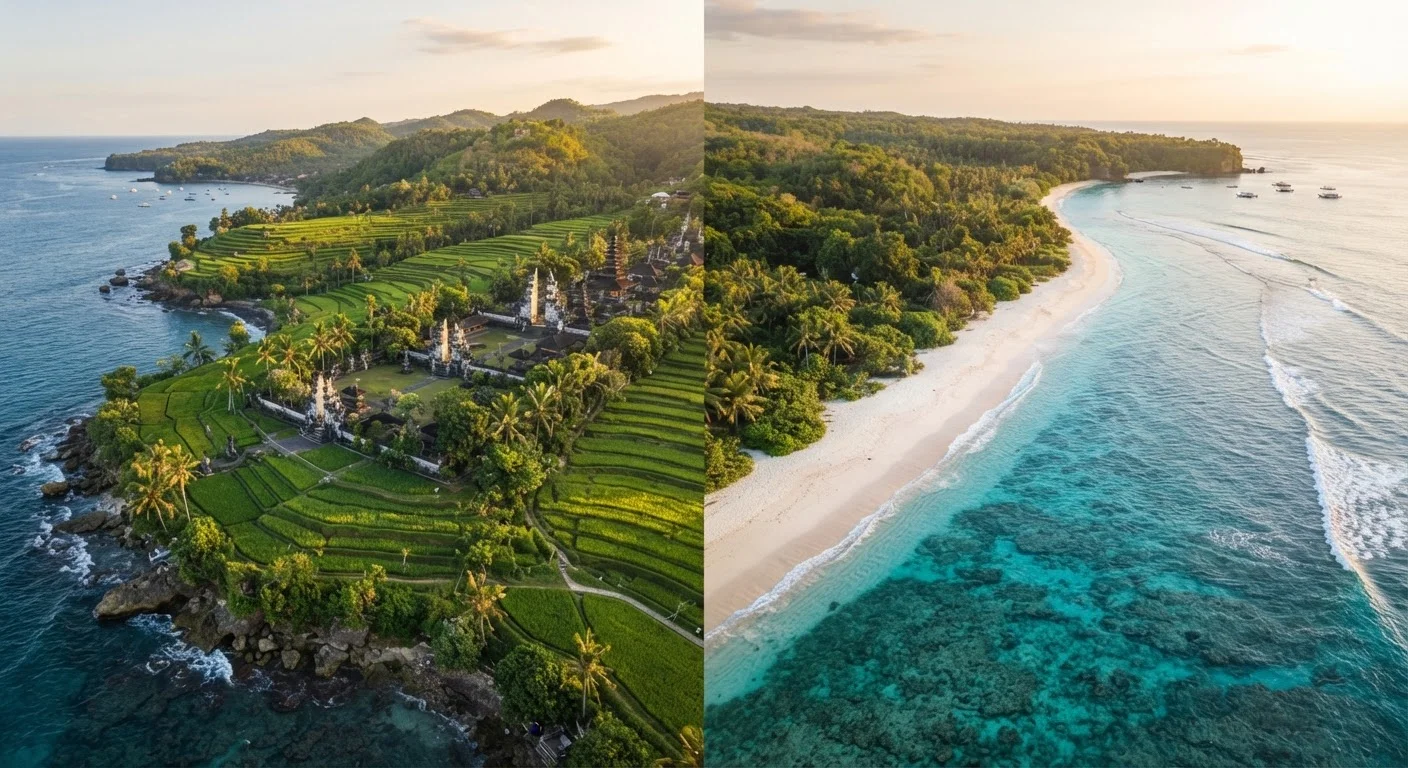
Option A
Bali
The culturally rich, well-connected classic.
Best for: Travelers who want established infrastructure, vibrant arts and spirituality, a wide dining scene, and easy trip logistics.
Option B
Lombok
The quieter, wilder alternative next door.
Best for: Travelers seeking uncrowded beaches, serious trekking, and a slower pace with fewer tourist crowds.
The Essential Difference: Vibe and Infrastructure
Bali and Lombok are separated by a narrow strait but feel worlds apart in pace and personality. Bali is Indonesia's most visited island for a reason: decades of tourism investment have produced a seamless travel ecosystem. International flights land at Ngurah Rai Airport, accommodation ranges from budget guesthouses to luxury villas, and a dense network of drivers, tour operators, and restaurants caters to virtually every preference.
Lombok, by contrast, remains considerably less developed outside its main hub of Mataram and the fast-growing south coast. Lombok International Airport receives fewer direct international routes, and onward transport across the island demands more patience and planning. That's not a flaw — for many travellers, it's exactly the point. If you find Bali's busiest corridors overstimulating, Lombok's quieter roads and emptier shores can feel like a revelation.
Think about your travel style before you book. If you prefer structure and ease, Bali delivers. If you're comfortable with a bit of improvisation and value solitude over convenience, Lombok rewards the extra effort. For a deeper look at how pace shapes a trip, see our guide to slow travel vs. fast-paced itineraries.
| Criterion | Bali | Lombok |
|---|---|---|
| International flight access | Extensive — major hub | Limited direct routes |
| Crowd levels | High in peak season | Generally quieter |
| Cultural highlights | Rich Hindu-Balinese temples and arts | Sasak villages and Islamic heritage |
| Signature activity | Temple hopping, rice terrace walks | Mount Rinjani trek |
| Beach scene | Varied but often busy | Pristine and uncrowded |
| Diving & snorkeling | Good (Amed, Nusa Penida nearby) | Excellent via Gili Islands |
| Food & dining variety | Extensive, international options | Smaller scene, strong local cuisine |
| Budget range | Budget to ultra-luxury | Mostly budget to mid-range |
Nature, Activities, and What Each Island Does Best
Bali punches above its size when it comes to variety. Ubud's rice terraces and monkey forests, the volcanic crater lake at Batur, the surf beaches of Canggu and Uluwatu, and the snorkeling reefs around Amed all occupy a single manageable island. This density makes Bali particularly efficient for travellers on shorter trips who want a broad cross-section of experiences.
Lombok counters with depth over breadth. Its defining natural feature is Mount Rinjani, an active stratovolcano whose summit sits at 3,726 metres. The two- to four-day guided trek to the crater rim and the caldera lake is one of Southeast Asia's most demanding and rewarding hikes. Permits and registered guides are required, and trek logistics should be arranged well in advance through officially licensed operators.
Off the island's northwest coast, the Gili Islands — Gili Trawangan, Gili Meno, and Gili Air — are accessible via short boat transfer and are celebrated for exceptional snorkeling, sea turtle encounters, and a laid-back atmosphere. Motorised vehicles are banned on all three islands, giving them an unhurried character that contrasts sharply with busier Balinese beach towns.
3,726 m
Height of Mount Rinjani
Mount Rinjani is Indonesia's second-highest volcano and one of Southeast Asia's most popular multi-day trekking destinations.
~6 million
Annual visitors to Bali (pre-pandemic)
Bali consistently ranked among the world's top island destinations by volume of international arrivals, according to Indonesian tourism statistics.
2–4 hours
Fast boat crossing from Bali to Lombok
Several fast boat services operate daily between Padang Bai (Bali) and Bangsal or Teluk Nare (Lombok), making island-hopping practical.
Bali's surf scene is concentrated and well-serviced; Lombok's surf, particularly around Gerupuk and Desert Point, draws experienced riders seeking less-crowded lineups. Divers will find strong options on both islands, though Lombok's proximity to the Gilis gives it an edge for dedicated underwater explorers.
Culture, Food, and Practical Considerations
Bali's Hindu-Balinese culture is the island's most distinctive quality. Elaborate temple ceremonies, intricate stone carvings, traditional Kecak dance performances, and the daily practice of placing handwoven canang sari offerings create a living cultural landscape unlike anywhere else in Indonesia. Ubud, in particular, supports a thriving arts community with galleries, craft workshops, and music that visitors can engage with respectfully and meaningfully.
Lombok is predominantly Muslim, offering a culturally distinct experience. The indigenous Sasak people have their own weaving traditions, cuisine, and village customs worth exploring beyond the beach resorts. Local dishes such as ayam taliwang (spiced grilled chicken) and plecing kangkung (water spinach with chili sauce) reflect a bold culinary identity separate from Balinese cooking.
Respecting Local Customs on Both Islands
Both Bali and Lombok have sacred sites and community norms that visitors are expected to honour. In Bali, temple visits require a sarong and sash, and menstruating visitors are asked not to enter certain shrines. In Lombok's Sasak villages and near mosques, modest dress is appropriate. Travellers who approach both islands with cultural curiosity and basic respect will find communities genuinely welcoming.
On the practical side: Bali's tourism infrastructure means finding English-language signage, ATMs, medical facilities, and communication services is straightforward. Lombok is catching up, but travellers venturing beyond Senggigi or the south coast should plan with more self-sufficiency. Travel insurance covering medical evacuation is strongly advisable for both destinations, particularly for Rinjani trekkers. Always verify current visa requirements, entry health protocols, and any travel advisories through your government's official travel advisory service and Indonesia's immigration authority before departure.
The content on this site is for informational purposes only and is not a substitute for professional advice. Always consult a qualified professional for guidance specific to your situation.