

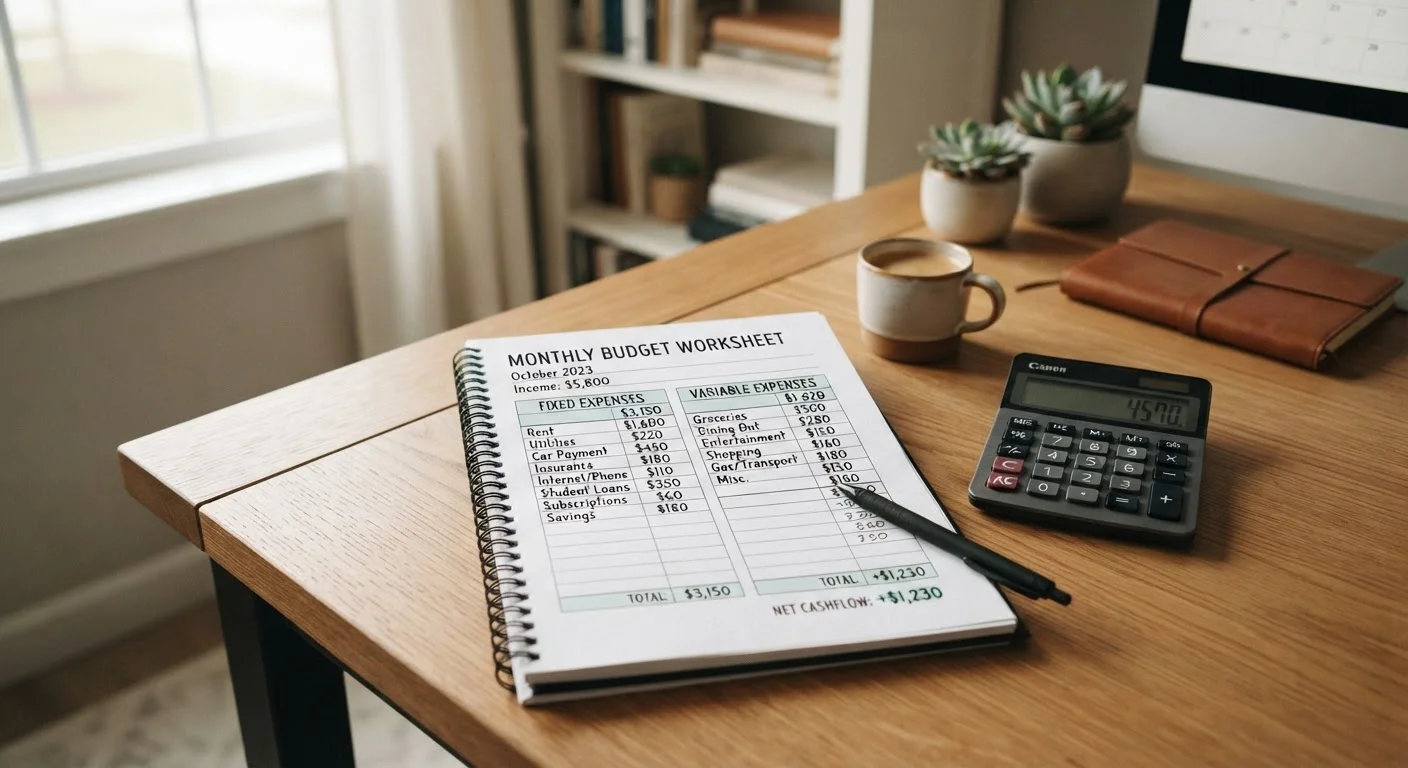
Option A
Fixed Expenses
The predictable, non-negotiable costs that anchor your budget.
Best for: Establishing a reliable spending floor so you always know your minimum monthly obligations.
Option B
Variable Expenses
The flexible, fluctuating costs where most spending adjustments happen.
Best for: Identifying the areas of your budget where conscious choices can meaningfully change your financial picture.
What Makes an Expense Fixed or Variable?
At its core, the distinction is about predictability. A fixed expense is one that costs roughly the same amount each billing cycle regardless of how you use it. Rent or mortgage payments, car loan installments, insurance premiums, and most subscription services fall into this category. You owe them whether you use the service or not, and the amount doesn't change based on your behavior.
A variable expense, by contrast, fluctuates based on consumption or circumstance. Groceries, gas, utilities beyond a base rate, dining out, and clothing are all variable — spend more, pay more; spend less, pay less. This behavioral link is what makes them the more flexible half of any budget.
A third category worth recognizing is semi-variable expenses — costs that have a fixed base component and a variable layer on top. Your electric bill, for instance, may carry a fixed service charge plus a usage-based amount. Understanding which portion is controllable helps you target efforts more precisely.
| Criterion | Fixed Expenses | Variable Expenses |
|---|---|---|
| Amount each month | Stays the same | Changes based on use or choice |
| Examples | Rent, loan payments, insurance | Groceries, gas, dining, clothing |
| Control level | Low — often contractually set | High — driven by daily decisions |
| Easiest to cut short-term | No — requires renegotiation | Yes — reduce immediately |
| Best for long-term savings | Yes — permanent if reduced | Moderate — requires ongoing discipline |
| Budget planning role | Sets your spending floor | Defines your spending range |
Why the Distinction Changes How You Budget
When you separate your expenses into these two buckets, something clarifying happens: you can immediately see how much financial flexibility you actually have. Fixed expenses define your spending floor — the amount you must cover every month no matter what. Variable expenses define your spending range — the zone where decisions either stretch or compress your budget.
This matters most when your income changes. If you lose a client, take unpaid leave, or face an unexpected expense, fixed costs don't adjust — they're still due. Variable costs, on the other hand, can often be trimmed in the short term without any long-term consequence. Knowing this in advance means you're not making frantic decisions mid-crisis; you've already mapped the levers available to you.
~60%
Share of average household budget in fixed costs
Federal Reserve and Bureau of Labor Statistics data consistently show housing, transportation, and insurance commitments comprise the majority of household spending for most Americans.
1 in 3
Americans with no monthly budget
Surveys from the National Financial Educators Council have found a significant share of U.S. adults do not maintain a formal budget, often because they lack a clear framework for categorizing expenses.
For those managing an uneven paycheck, this framework is especially useful. Our guide on budgeting with irregular income explores how variable earners can build a financial cushion by keeping fixed commitments lean relative to their lowest-earning months.
Practical Steps: Sorting and Acting on Your Expenses
Start by pulling three months of bank and credit card statements. For each recurring charge, ask: Does this amount stay the same regardless of what I do? If yes, it's fixed. If it changes based on usage or choice, it's variable. Build two lists.
Once sorted, add up your fixed expenses. That total is your non-negotiable monthly commitment. Subtract it from your take-home pay. What remains is your working budget for variable costs and savings goals.
If you want to reduce spending, look first at your variable list — these are where spending habits live. Eating out less, consolidating streaming services, or batching errands to cut fuel costs are all variable adjustments. For deeper, more lasting relief, examine your fixed list: Could you refinance at a lower rate? Downgrade a plan? Eliminate a subscription you've auto-renewed without noticing? Changes here are harder but create permanent savings.
Don't overlook irregular costs that only appear a few times a year — annual fees, vehicle registration, or seasonal expenses. These are discussed further in our article on spending categories most budgets overlook. The practical move is to divide annual costs by 12 and treat that monthly slice as a fixed obligation.
If you're just getting started, our step-by-step monthly budget guide walks through the full process of mapping income to categories — and this fixed/variable framework fits naturally into that structure. For a broader look at how all the pieces connect, see our complete guide to budgeting basics.
Semi-Variable Expenses Need a Closer Look
Utilities, phone bills, and some insurance plans have both fixed and variable components. For budgeting purposes, use your average over three to six months as a working estimate for the fixed portion. Track usage patterns separately to identify where you can trim the variable layer. This approach keeps your budget realistic without requiring perfect monthly precision.
This article is for general informational and educational purposes only and does not constitute personalized financial advice. Consider consulting a qualified financial professional for guidance specific to your situation.
The content on this site is for informational purposes only and is not a substitute for professional advice. Always consult a qualified professional for guidance specific to your situation.