

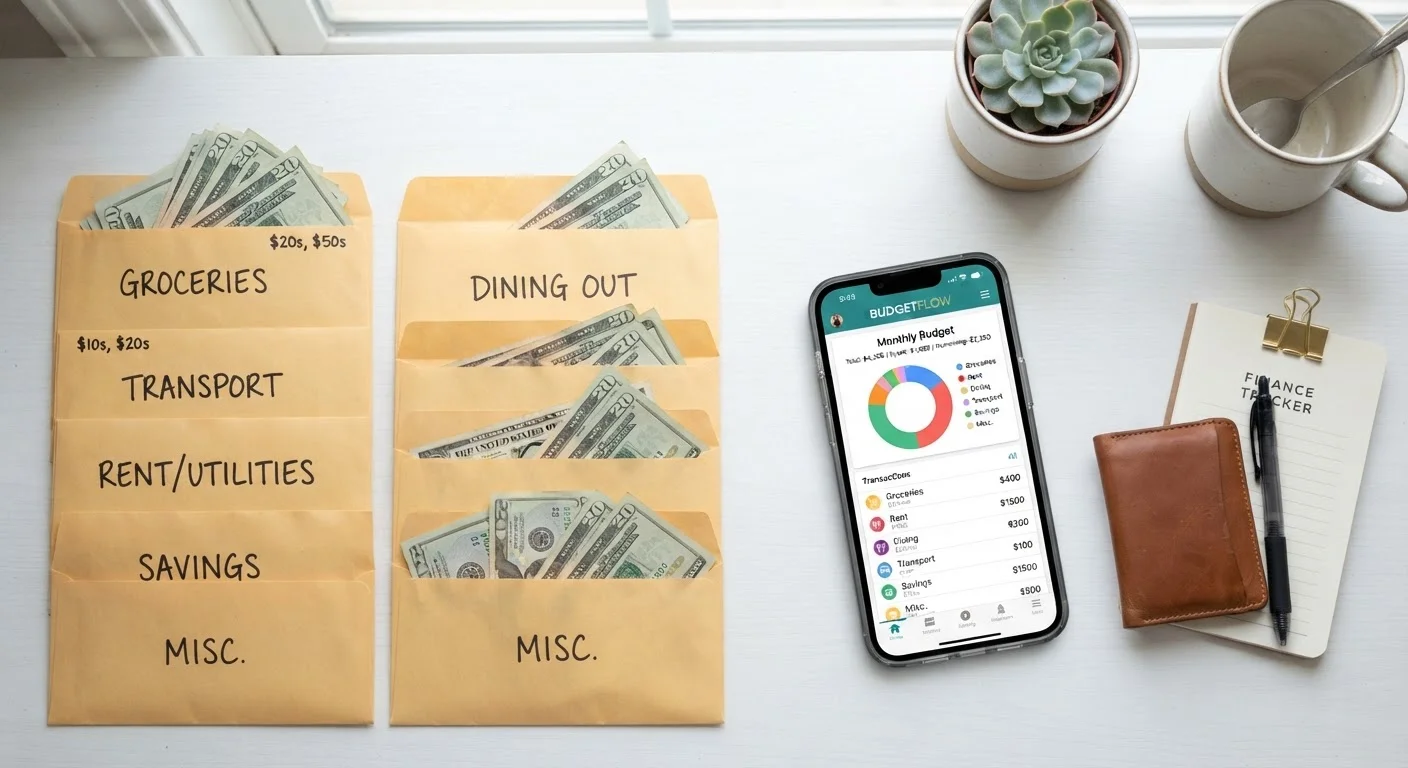
Option A
Envelope Budgeting
The tactile, cash-based method that makes limits impossible to ignore.
Best for: Hands-on learners and people who tend to overspend when using cards.
Option B
Digital Spending Trackers
The automated, data-rich approach for managing money across accounts.
Best for: Tech-comfortable earners who prefer real-time insights and minimal cash handling.
How Each System Actually Works
Envelope budgeting is a zero-based cash method. At the start of each pay period, you withdraw your budgeted spending money and divide it into labeled envelopes — groceries, dining, transport, entertainment, and so on. When an envelope is empty, spending in that category stops until the next cycle. The system was popularized by financial educator Dave Ramsey, though the underlying concept predates him by generations.
Digital spending trackers work differently. Apps or software sync with your bank accounts and cards, automatically categorizing each transaction. You set spending targets per category, and the app alerts you as you approach or exceed them. Some platforms also analyze patterns over time, flagging spending categories most budgets overlook — things like annual subscriptions and irregular car costs that rarely appear in a standard monthly plan.
Both methods share the same core goal: making spending visible before it spirals. Their differences lie in friction, flexibility, and how well they fit real-world behavior.
| Criterion | Envelope Budgeting | Digital Spending Trackers |
|---|---|---|
| Payment method | Cash only | Cards, bank accounts, digital payments |
| Setup effort | Low — just envelopes and cash | Moderate — account linking and category mapping |
| Spending friction | High — physical cash limits overspending | Low — notifications are easy to ignore |
| Automation | None — fully manual | High — transactions logged automatically |
| Handling fixed/online bills | Awkward or impossible | Seamless |
| Data and reporting | None built-in | Detailed spending history and trends |
| Cost | Free | Free to paid subscription tiers |
| Best suited to | Discretionary, everyday spending | Full financial picture across accounts |
Strengths and Limitations of Each Approach
Envelope budgeting excels where psychology and habit intersect. Research in behavioral economics consistently shows that people spend less when using cash compared to cards — a concept sometimes called the "pain of paying." Physical depletion of an envelope is a concrete signal that no app notification quite matches. The system also requires no technology, no data sharing, and no monthly subscription fee.
Its limitations are real, however. Carrying cash creates security risks, and many essential expenses — utility bills, online purchases, rent — don't lend themselves to cash transactions. Withdrawing the right denominations each pay period takes planning, and any variance in income can throw the system off quickly.
Digital trackers remove most of that friction. Card-based spending is captured automatically, and most platforms generate detailed reports that support a monthly budget health check. They adapt easily to variable income and complex financial lives.
The core weakness is the absence of friction. Seeing a warning notification is cognitively easy to dismiss — unlike an empty envelope. Trackers also require consistent setup, category mapping, and periodic review to deliver value. Without that engagement, they become expensive dashboards you rarely open.
~18%
Less spending when using cash vs. cards
Studies in behavioral economics, including work by Drazen Prelec and Duncan Simester, suggest cash transactions create greater psychological 'pain of paying' than card payments.
60%+
Americans living paycheck to paycheck
Multiple annual surveys by financial research organizations consistently find the majority of U.S. adults have little financial cushion, underscoring the importance of active budget management.
1 in 3
Budgeters who don't track spending regularly
Federal Reserve surveys on household economic well-being indicate a significant share of Americans who set budgets do not consistently monitor actual spending against them.
Choosing the Right Fit — or Combining Both
The right budgeting framework is the one you'll actually use. If you're building foundational habits and find overspending on everyday categories like groceries or dining is your pressure point, envelope budgeting's physical constraints can accelerate discipline. If your financial life spans multiple accounts, automatic bill payments, and variable monthly costs, a digital tracker offers the scope that cash envelopes can't.
A hybrid approach is also worth considering. Some people use digital trackers for fixed and bill-pay expenses while maintaining cash envelopes for the two or three discretionary categories where they most often overspend. This captures the automation benefits of technology while preserving cash's behavioral friction where it matters most.
Whichever direction you take, it fits within a broader budgeting foundation. If you're still building that foundation, the complete guide to budgeting basics covers income mapping, expense categorization, and emergency fund planning end to end. And if maintaining long-term budget discipline is the challenge, sticking to a budget without cutting out everything you enjoy offers evidence-backed strategies that don't require eliminating enjoyment.
A Note on Hybrid Budgeting
There is no rule requiring you to commit fully to one system. Many households find it effective to use digital tracking for fixed expenses — rent, utilities, insurance — while reserving cash envelopes for two or three high-risk discretionary categories. This approach also pairs well with the pay-yourself-first method, where savings are moved automatically at the start of each pay period before the remainder is allocated to either system.
This article is for general informational and educational purposes only and does not constitute personalized financial advice. For guidance tailored to your specific financial situation, consider consulting a licensed financial professional.
The content on this site is for informational purposes only and is not a substitute for professional advice. Always consult a qualified professional for guidance specific to your situation.