

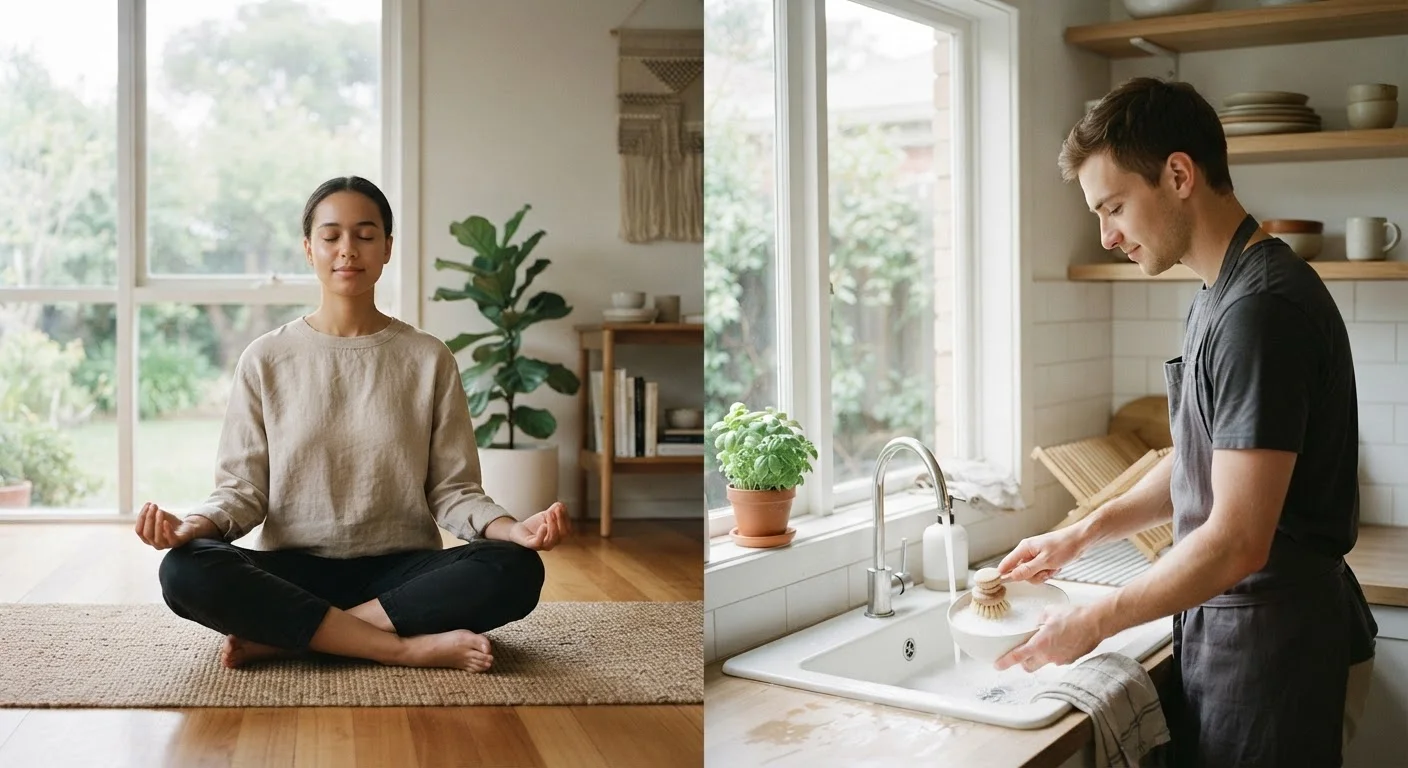
Option A
Mindfulness
The moment-to-moment awareness you can practice anywhere.
Best for: People who want to reduce stress and improve focus throughout daily activities without setting aside dedicated practice time.
Option B
Meditation
The structured, intentional training session for the mind.
Best for: People seeking a deliberate, repeatable mental training practice with measurable depth and consistency over time.
Defining the Terms Clearly
The words mindfulness and meditation are often used as if they mean the same thing. They do not — though they are closely related. Understanding the distinction matters because it shapes how you approach each practice and what you can realistically expect from it.
Mindfulness is a mental quality: the capacity to pay deliberate, non-judgmental attention to the present moment. It can be applied at any time — while eating, walking, or listening to a colleague. It does not require a cushion, a quiet room, or a timer.
Meditation is a formal practice: a structured activity, usually time-bound and intentional, in which you train the mind by directing attention according to a specific technique. Most meditation forms involve mindfulness as their core mechanism, but some (such as loving-kindness or visualization practices) extend beyond pure awareness.
A useful analogy: mindfulness is to meditation what fitness is to exercise. Fitness is the quality; exercise is one primary way to develop it. You can build fitness through daily movement without ever entering a gym — but structured training accelerates progress. For a broader view of how these practices fit into overall wellbeing, see what mental wellness actually means.
| Criterion | Mindfulness | Meditation |
|---|---|---|
| What it is | A quality of present-moment awareness | A structured practice or technique |
| When it happens | Anytime, during daily activities | During a dedicated, intentional session |
| Time required | No set time — seconds to hours | Typically 5–45 minutes per session |
| Equipment or setting needed | None | Quiet space; optional cushion or app |
| Primary mechanism | Non-judgmental present-moment attention | Directed attention training via technique |
| Research evidence | Strong, especially via MBSR programs | Growing, particularly in neuroimaging studies |
| Relationship to the other | Can exist independently of meditation | Almost always involves mindfulness |
What the Research Actually Shows
Both practices have a substantial evidence base, though the quality and specificity of that evidence varies.
~47%
Time the mind wanders from the present
A Harvard study by Killingsworth and Gilbert (2010) found that people spend nearly half their waking hours thinking about something other than what they are currently doing.
8 weeks
Duration of standard MBSR program
The Mindfulness-Based Stress Reduction program studied in dozens of clinical trials runs for eight weeks of structured mindfulness and meditation training.
Moderate
Evidence grade for anxiety reduction
A 2014 JAMA Internal Medicine meta-analysis rated mindfulness meditation programs as having moderate evidence for improving anxiety, depression, and pain outcomes.
Mindfulness-Based Stress Reduction (MBSR), an eight-week structured program developed by Jon Kabat-Zinn at the University of Massachusetts, has been studied extensively. Systematic reviews — including work published in journals such as JAMA Internal Medicine — indicate that mindfulness-based programs are associated with moderate reductions in anxiety, depression, and pain. Importantly, MBSR blends formal meditation sessions with the cultivation of everyday mindfulness, illustrating how the two practices reinforce each other.
Formal meditation, particularly focused-attention and open-monitoring styles, has been linked in neuroimaging research to structural changes in brain regions associated with attention and self-regulation. However, researchers note that many early studies had small sample sizes, and the field is still establishing which specific techniques produce which specific outcomes for different populations.
The honest takeaway: both practices show genuine promise, but neither is a clinical intervention on its own. They are best understood as supportive tools within a broader approach to mental wellness. If you are managing a diagnosed mental health condition, consult a qualified healthcare professional before relying solely on mindfulness or meditation as treatment. Therapy, coaching, and counselling remain distinct and often necessary supports.
How to Use Both in Daily Life
The most practical approach for most people is not to choose between mindfulness and meditation but to understand how they work together at different moments of the day.
Informal mindfulness practice
Bring deliberate, non-judgmental attention to routine activities: notice the sensation of water during a shower, the taste of each bite during a meal, or the physical sensation of breathing during a stressful meeting. These micro-moments of awareness are not trivial — accumulated across a day, they gradually shift the baseline responsiveness of the nervous system.
Formal meditation practice
Set aside a consistent block of time — even five to fifteen minutes — for structured practice. Focused-attention meditation (directing awareness to the breath and gently returning when the mind wanders) is the most widely researched entry point. Guided audio sessions via apps or recordings can support consistency, though mental health apps have both benefits and real limitations worth weighing before committing to any platform.
Pairing either practice with complementary habits — such as reflective journaling — can deepen self-awareness further. And if you are completely new to thinking about mental wellness habits, this grounded starting point for beginners covers the foundational concepts in plain language.
Mindfulness Is Not the Same as Relaxation
A common misconception is that mindfulness means feeling calm or clearing the mind of thoughts. It does not. Mindfulness involves observing thoughts, sensations, and emotions as they arise — including uncomfortable ones — without automatically reacting. Relaxation may follow, but it is a by-product, not the goal. This distinction matters because people who expect instant calm sometimes abandon the practice prematurely when difficult thoughts surface.
This article provides general health information for educational purposes only and is not a substitute for professional medical or mental health advice. Always consult a qualified healthcare professional about any concerns regarding your mental or physical health.
The content on this site is for informational purposes only and is not a substitute for professional advice. Always consult a qualified professional for guidance specific to your situation.